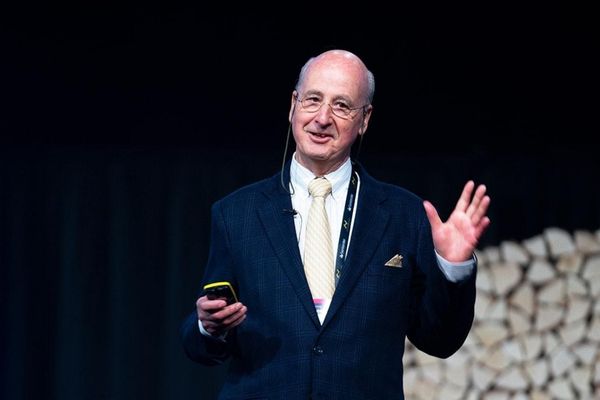
Stéphane Garelli
-
Economy
-
Leadership
-
Society & future
Professor Stéphane Garelli is a widely acclaimed expert in the field of competitiveness and has been a trailblazer in research and theory in this domain. He currently holds the position of Emeritus Professor at IMD Lausanne, where he established the Global Competitiveness Center. Additionally, he serves as Emeritus Professor of Global Competitiveness at the University of Lausanne.
With a profound grasp of the global economic landscape, Stéphane Garelli is a captivating speaker who masterfully combines informative content with an engaging approach to address intricate issues. He enhances his presentations with compelling graphics, encouraging companies and individuals to think creatively and align their strategies with contemporary market trends and competitive pressures.
Beyond his academic contributions, Professor Stéphane Garelli has held various influential positions. He served as chairman of the board of directors and shareholder of the prominent French-speaking Swiss newspaper, Le Temps, and held the same position in Sandoz Financial and Banking Holding. Additionally, he was a board member of Banque Edouard Constant. In the past, he was the Managing Director of the World Economic Forum and played a key role in organizing the Davos Annual Meetings for several years.
Professor Garelli is associated with numerous esteemed institutes, including the Chinese Association of Business Management, the Board of the Jean Monet Foundation for Europe, and the Swiss Academy of Engineering Sciences. Moreover, he is an active member of the International Olympic Committee’s Commission on Sustainability and Legacy.
When delivering speeches, Professor Garelli always strives to provide forward-looking content and insights tailored to the specific audience. He believes that being interesting is not enough; the content must inspire action and practical application. Thanks to his meticulous preparation, Stéphane’s presentations are rich in detail, offering profound insights and invaluable ideas.
Stéphane Garelli preferred topics
2023 : The Risk of Stagflation?
For the first time since the 1970s, the global economy faces the risk of sustained inflation and recession (or severe slowdown) simultaneously.
However, central banks, mainly in the United States and Europe, continue to prioritize the fight against inflation as their main priority. On the other hand, governments will continue to support consumers with generous subsidies to deal with energy-related difficulties or price increases. The resulting increase in debt is a problem pushed into the future. In many countries, an “at all costs” mindset is gaining momentum.
The dilemma is that the policies of central banks and many governments are incompatible. This conflict is in the background of all public decisions in 2023.
New Chapters in the Book of Globalisation
The golden age of globalization (1978 – 2018) was marked by the establishment of a unified global market with high profitability and profits. It could be summed up as “just in time”. Each nation could focus on what it did best, following the law of comparative advantage.
However, this has also led to over-specialization. Vulnerability and overdependence have become a major concern, both politically and economically, accentuated by the harshness of the Covid crisis.
A new chapter of globalization therefore emphasizes the decoupling of economies and the duplication of technologies. The aim is to reduce over-reliance on supplies from other countries. The goal is to develop a “just in case” model that is more secure, more resilient and more expensive.
The End of Low-Cost Globalisation?
Over the past 30 years, globalization has brought significant efficiency, broad product supply and low inflation to the global economy.
However, today, supply shortages, bottlenecks in deliveries, wage increases and inflation indicate that low-cost globalization has reached its limits. In addition, the harmonization of global taxation and the proliferation of regulations will significantly increase the cost of doing business.
A new economic model emphasizes security of supply and resilience rather than price competitiveness. Reliability becomes the key word.
A Black Hole Economy?
A few large corporations concentrate technology and financial power. The market capitalization of the ten largest global technology companies now exceeds the combined value of their counterparts in the banking and pharmaceutical sectors.
Tech giants don’t just innovate, they also embark on a strategy of acquiring promising start-ups, often above their market value. They use about 25% of their financial resources to buy successful innovative start-ups around the world.
Countries risk suffering the consequences of a huge economic black hole at the center of which high-performing technology companies attract and buy young companies using their enormous available cash.
As a result, many countries could now lose promising start-ups, which otherwise would have had the potential to become competitive national champions, creating jobs and paying taxes.
A Youthquake?
The emergence of millennials as consumers and employees is forcing companies to review their approach to products and markets.
This new generation is driven by the following elements:
- Meism, which is an egocentric approach to life,
- A concern for “transparency”, meaning that nothing should be confidential;
- A desire to “improve the state of the world”, in particular through sustainable development, biological diversity, energy transition, etc.
- A “free is awesome” mindset, involving a reassessment of business profitability models.
This new paradigm reinforces Peter Drucker’s statement:
”Changes in society now have more impact on companies than changes in management.”
It’s Time to be Bold!
“When everyone thinks the same way… perhaps no one thinks any more.”
Therefore, the upheaval of globalization must also be a moment of reinvention of products, business models and work structures.
The winners will be those who quickly identify the many opportunities in a rapidly changing environment. They will also implement their ideas faster than others.
The succession of crises we are experiencing (pandemics, wars, etc.) will accelerate change and innovation in companies. It will also mean spending more time adapting to new societal expectations and changing employee mindsets.
In short, it’s time to be bold!
Sujets populaires: 2023: The Risk of Stagflation? | Lower Inflation Does Not Mean Lower Prices | New Chapters in the Book of Globalization | A Fractured World? | Reviewing the Security of Assets | State Capitalism and Industrial Policies | The End of Low-Cost Globalization? | Technology Companies Are Breaking the Entry Barriers | A Black Hole Economy? | New Business Models | Consumers Have Their Own Priorities | The Company of Tomorrow | A Youthquake? | A Mindset for Competitiveness and Success | Time To Be Bold!
Book Stéphane Garelli
Fill in the form below to book the Speaker